Bill McMurdo claims on his blog that he encourages 'lively discussion' but that he doesn't want abusive remarks or bad language. A quick perusal of the posts on his blog shows that he doesn't adhere to this policy too strictly. In fact, there are only two kinds of post that Merlin doesn't like. The first is calling 'Rangers' a new team or saying that the club went into liquidation. The second is any criticism of the many pseudo-histories that Orangemen, and other extremist, right-wing Protestants hold so dear. Such a post is usually moderated out of existence.
Of course, they don't hold with any of the daft theories about Freemasons running the world or the Royal Family being alien lizards. Their reading matter of choice is almost exclusively about Roman Catholics running the world behind the scenes and about Roman Catholicism being a pagan religion, usually derived from Babylon somehow.
One of these was written by some headbanger of a Free-Church minister in the mid-Nineteenth Century, by the name of Alexander Hislop. His book is called 'The Two Babylons or The Papal Worship Proved to be the Worship of Nimrod and His Wife.' As you might expect, this book is a load of half-truths, utter shite and downright lies. The Orange bigots, however, lap it up like mother's milk.
If you've never heard of Nimrod, he's some king in the Book of Genesis, who supposedly lived around the time of Abraham. Nobody has figured out who the hell this guy is, although plenty of candidates have been put forward. Auld Hislop, however, has it all figured out. Nimrod was king of Babylon and he insisted that he be worshipped as a god. Nimrod's wife, Semiramis, was also worshipped as a goddess. The fact that Semiramis was apparently born a couple of hundred years after the time that Nimrod was supposedly shagging her in a god-like fashion seems to concern Hislop not a jot.
Anway, Hislop posits all kinds of convoluted theories about ancient religions to reach the point where the Catholic Church, at the time of Constantine, adopted the worship of pagan, Roman gods. Why they should have done this is not explained. He makes the claim that pictures of Mary with the baby Jesus are, in reality, some Roman goddess, while the baby was 'Jupiter-Puer' or the baby Jupiter. The fact is that the Romans had no such cult of Jupiter as a child and Hislop was the first person to come up with the name, 'Jupiter-Puer.'
Hislop outlines the practices of the Ancient Greek Eleusinian Mysteries, even though nobody knows anything about this cult's practices or even who they worshipped. His whole book is made up of ridiculous nonsense like this, which normal scholars find laughable.
Another bam they all orgasm over is Tupper Saussy, a bitter wee man with a chip on his shoulder about the American Government. This guy spouts the same pish as Hislop and tries to prove that the 'pagan' RC Church runs the world. Again, his book is full of all manner of crap. He claims that the Dog Star, Canis Major, is named after Cain, when anybody with even the most rudimentary knowledge of Latin knows that 'canis' is Latin for 'dog.' He also says that the title 'Pontifex Maximus' was a Babynonian one, which was adopted in Rome in 48BC, even though the title went back to the times of the kings in Rome, about 500 years before!
Another guy called Ralph Woodrow wrote a similar book, based on Hislop's 'findings' and was embarrassed to later discover that it was a load of Craig Whyte. He pulled the book from circulation, even though it was a bestseller. Of course, he has since received death threats from extremist Protestants around the world. It seems that The Peeppell are the same everywhere!
If you have a look on Amazon you can find dozens of these pathetic attempts to rewrite history. Or you can find some of them on McMurdo's website, including some that he's written himself! They all have one thing in common: anti-Catholicism. Haven't these people got anything better to do with their lives?
From believing these ridiculous versions of history, which even David Icke would laugh at, it's but a short steop to believe any old crap, like Ireland refueling U-boats and even a dead club not being dead after all!
Friday, 8 November 2013

Thursday, 7 November 2013
REMEMBRANCE
It's fast approaching that time of year again. No, I don't mean Christmas; I'm talking about Remembrance Day. Years ago you would buy a poppy, observe the silence and think about those poor souls that were butchered on the fields of France and Belgium. Nowadays, however, it's a different matter entirely. It's turned into some kind of maudlin circus, where it's no longer to do with remembering the dead, but as a test of loyalty and support for the British armed forces. The display at Ibrox last year is a case in point; it had nothing to do with remembering the dead and everything to do with jingoism and nationalism.
The story we are being fed time and again is that all those men died to guarantee our freedoms. Did they? What threat to our freedom did Germany pose in 1914? The answer is none whatsoever. The truth is that the First World War was a war of imperialism, nothing else. No doubt the ordinary people in Austria, France, Italy, Russia, Turkey etc were told that they were fighting for their freedom as well. We know full well that this was certainly the case in Germany. You only have to read Remarque's 'All Quiet on the Western Front', or watch the film, to find out that the Germans were told the same lies.
So what was the war really all about? The jury is still out on that one. Only one person has seen fit to look behind the scenes and find out what was going on. Fritz Fischer's 'Germany's Aims in the First World War' caused outrage in his native land when it first appeared in the early 1960s. He shows that the German elite went to war with the sole purpose of gaining more land, especially in the East. His book is now required reading for any serious student of the First World War. It also encouraged German historians to look more closely at what went on in their own country under the Nazis.
So what about the other countries? Austria was determined to hold onto her splintering empire in the Balkans, Turkey was in the same position, Russia had been after ports in the Mediterranean/Adriatic for at least a century, while France was looking for revenge for the Franco-Prussian War and the return of Alsace-Lorraine. Italy, although allied to Germany and Austria, joined the other side, partially through opportunism, partly through long-standing hatred of Austria. It should be remembered, of course, that when I am talking about a country I am really talking about that country's ruling elite.
But what of Britain; why did she enter the war? I remember a tutor at university telling us that there was a book written about Britain's reasons for going to war. The woman that wrote it, however, was related to many in the upper echelons of British society and her book was a whitewash. It was a salutory lesson in checking the credentials of your sources, said our tutor. The problem is that, even a hundred years later, nobody has performed a critical analysis of why Britain went to war. A search on the internet shows that the story of Britain going to war for noble and altruistic reasons is still the general opinion.
This makes the idea of four-years' worth of 'commemoration' of the First World War, starting next year, a bit suspect. Part of the four-years' programe includes 'education.' Considering what I've already pointed out, this 'education' is going to be nothing more than propaganda; reinforcing the myth that all those men died to protect our freedom.
Everyone has somebody that died in the First World War in their family and I'm no exception. Equally not exceptional, sadly, was the circumstances of my relative's death. My grandfathers were too young to have fought in WWI, while my great-grandfathers were too old. My maternal grandfather's older brother, Michael, however, joined up. Michael was only fifteen when he took the King's Shilling, no questions asked. After nearly a year in the trenches he was quite probably a nervous wreck. One morning they were ordered 'over the top'; Michael just could not do it. He was terrified, a frightened young boy, and cowered, crying, curled up in a ball on the floor of the trench. His captain shot him in the head.
That's not the end of the story. The ordinary soldiers were quite protective of young Michael and the Captain caught a 'stray' bullet in the back during the attack. Friendly Fire, I think they call it nowadays. So, on Remembrance Day, am I to remember the poor great-uncle I never knew, or just the 'heroes' that fell in the heat of battle? And what about that captain; am I to remember his 'sacrifice'?
Hundreds of broken men, suffering from post-traumatic stress disorder, or shell shock, were lined up and shot by firing squad or by their immediate commanding officer if it was during a battle. Are we to remember these 'cowards,' as they were termed, even being accused of cowardice after the war was over?
After the war my grandfather's family's grief was compounded by the death of his grandmother. She was an aged widow, who still lived in a small cottage in Ireland. She was dragged from her cottage for no reason by the Black and Tans. They poured petrol over her and set her alight, making bets as to how long it would take her to die. Am I to remember her and how she died with 'heroes' of the British Army laughing and joking and stopping anyone that tried to help her? If those men were later killed by the IRA am I to rememer, and be grateful for, their 'sacrifice'?
Till the day he died my grandfather always went on about hating the British, after what they did to his family. My granny used to tell him to 'shut up' and said that his family were all 'Communists' anyway! If I was to tell certain people about my grandfather their answer would be that he should have 'fucked off home,' even though he, and his mother before him, was born in this country. It seems that to criticise any past, or current, behaviour of our government, or its representatives, is seen to be disloyal and anti-British and as proof that you don't belong here.
This is what the poppy has come to represent; not remembrance, but support for any and all wars that our armed forces have ever engaged in. I have seen letters in the newspapers suggesting, nay demanding, that everyone should boycott shops where the person behind the counter is not wearing a poppy, that we should refuse our custom to any place that does not have poppies on display and that no business should be done with anyone that does not wear a poppy. 'Poppy Fascism,' people are starting to call it. It reminds me of something in the Book of Revelation: everyone has to wear the 'Mark of The Beast' and nobody can do business or any transaction if they do not carry this mark.
That's why I'm not wearing a poppy this year. The whole thing has changed beyond recognition and is no longer about remembrance. Rather than remembering our war dead, we are now to remember their 'sacrifice' and pretend that all those young men died at the Somme, Ypres and Paschendale to protect our freedom, instead of the reality of dying for the ambitions of our ruling elite, as they continue to do.
The story we are being fed time and again is that all those men died to guarantee our freedoms. Did they? What threat to our freedom did Germany pose in 1914? The answer is none whatsoever. The truth is that the First World War was a war of imperialism, nothing else. No doubt the ordinary people in Austria, France, Italy, Russia, Turkey etc were told that they were fighting for their freedom as well. We know full well that this was certainly the case in Germany. You only have to read Remarque's 'All Quiet on the Western Front', or watch the film, to find out that the Germans were told the same lies.
So what was the war really all about? The jury is still out on that one. Only one person has seen fit to look behind the scenes and find out what was going on. Fritz Fischer's 'Germany's Aims in the First World War' caused outrage in his native land when it first appeared in the early 1960s. He shows that the German elite went to war with the sole purpose of gaining more land, especially in the East. His book is now required reading for any serious student of the First World War. It also encouraged German historians to look more closely at what went on in their own country under the Nazis.
So what about the other countries? Austria was determined to hold onto her splintering empire in the Balkans, Turkey was in the same position, Russia had been after ports in the Mediterranean/Adriatic for at least a century, while France was looking for revenge for the Franco-Prussian War and the return of Alsace-Lorraine. Italy, although allied to Germany and Austria, joined the other side, partially through opportunism, partly through long-standing hatred of Austria. It should be remembered, of course, that when I am talking about a country I am really talking about that country's ruling elite.
But what of Britain; why did she enter the war? I remember a tutor at university telling us that there was a book written about Britain's reasons for going to war. The woman that wrote it, however, was related to many in the upper echelons of British society and her book was a whitewash. It was a salutory lesson in checking the credentials of your sources, said our tutor. The problem is that, even a hundred years later, nobody has performed a critical analysis of why Britain went to war. A search on the internet shows that the story of Britain going to war for noble and altruistic reasons is still the general opinion.
This makes the idea of four-years' worth of 'commemoration' of the First World War, starting next year, a bit suspect. Part of the four-years' programe includes 'education.' Considering what I've already pointed out, this 'education' is going to be nothing more than propaganda; reinforcing the myth that all those men died to protect our freedom.
Everyone has somebody that died in the First World War in their family and I'm no exception. Equally not exceptional, sadly, was the circumstances of my relative's death. My grandfathers were too young to have fought in WWI, while my great-grandfathers were too old. My maternal grandfather's older brother, Michael, however, joined up. Michael was only fifteen when he took the King's Shilling, no questions asked. After nearly a year in the trenches he was quite probably a nervous wreck. One morning they were ordered 'over the top'; Michael just could not do it. He was terrified, a frightened young boy, and cowered, crying, curled up in a ball on the floor of the trench. His captain shot him in the head.
That's not the end of the story. The ordinary soldiers were quite protective of young Michael and the Captain caught a 'stray' bullet in the back during the attack. Friendly Fire, I think they call it nowadays. So, on Remembrance Day, am I to remember the poor great-uncle I never knew, or just the 'heroes' that fell in the heat of battle? And what about that captain; am I to remember his 'sacrifice'?
Hundreds of broken men, suffering from post-traumatic stress disorder, or shell shock, were lined up and shot by firing squad or by their immediate commanding officer if it was during a battle. Are we to remember these 'cowards,' as they were termed, even being accused of cowardice after the war was over?
After the war my grandfather's family's grief was compounded by the death of his grandmother. She was an aged widow, who still lived in a small cottage in Ireland. She was dragged from her cottage for no reason by the Black and Tans. They poured petrol over her and set her alight, making bets as to how long it would take her to die. Am I to remember her and how she died with 'heroes' of the British Army laughing and joking and stopping anyone that tried to help her? If those men were later killed by the IRA am I to rememer, and be grateful for, their 'sacrifice'?
Till the day he died my grandfather always went on about hating the British, after what they did to his family. My granny used to tell him to 'shut up' and said that his family were all 'Communists' anyway! If I was to tell certain people about my grandfather their answer would be that he should have 'fucked off home,' even though he, and his mother before him, was born in this country. It seems that to criticise any past, or current, behaviour of our government, or its representatives, is seen to be disloyal and anti-British and as proof that you don't belong here.
This is what the poppy has come to represent; not remembrance, but support for any and all wars that our armed forces have ever engaged in. I have seen letters in the newspapers suggesting, nay demanding, that everyone should boycott shops where the person behind the counter is not wearing a poppy, that we should refuse our custom to any place that does not have poppies on display and that no business should be done with anyone that does not wear a poppy. 'Poppy Fascism,' people are starting to call it. It reminds me of something in the Book of Revelation: everyone has to wear the 'Mark of The Beast' and nobody can do business or any transaction if they do not carry this mark.
That's why I'm not wearing a poppy this year. The whole thing has changed beyond recognition and is no longer about remembrance. Rather than remembering our war dead, we are now to remember their 'sacrifice' and pretend that all those young men died at the Somme, Ypres and Paschendale to protect our freedom, instead of the reality of dying for the ambitions of our ruling elite, as they continue to do.
Friday, 1 November 2013
WILL THE REAL NAZIS PLEASE STAND UP
"If Hitler invaded hell I would make at least a favourable reference to the devil in the House of Commons."
This is what Winston Churchill said regarding the Soviet Union being suddenly thrown on the side of Britain by Hitler's invasion of Russia. It is quite apt and worth bearing in mind when reading or hearing the usual Orangeman's diatribe about the Irish during the Second World War.
The Vanguard Bears website yesterday carried the usual disinformation about Ireland during WWII. The piece was written by somebody calling himself General Schomberg, who decides to regurgitate the same old lies that have been peddled for years. These include the lie that Ireland allowed German U-Boats to refuel in Irish ports and the ridiculous story that the Irish kept their lights on at night to guide German bombers to Liverpool etc. They must have been really strong lights!
The reality is that, although Ireland was ostensibly neutral, the Irish government actually worked closely with Britain against the Nazis. This included the forwarding of intelligence information, the allowing of Britain to enter Irish airspace and waters and the drawing up of plans in the event of a German invasion of Ireland. Plan W, as it was called, detailed the sending of troops from Britain to fight, along with the Irish, against the invaders.
In point of fact, many Irishmen volunteered to fight in the British army against the Nazis and Irish coastal areas suffered destruction from German bombing raids that had overshot their targets. (So much for them being guided in by Irish lights!)
Contrast this with the behaviour of another neutral country, Switzerland. Although the Swiss stayed out of the war they provided banking services for the Nazis, with no questions asked. Bank vaults were filled with stolen treasures, money stolen from Jewish businesses and even gold gleaned from the fillings of Jewish extermination camp victims. But, then, Switzerland is a Protestant country so the Orangemen will gloss over any infractions of that particular nation.
Meanwhile in South Africa, a British Colony, which joined the war on the side of the Allies, members of the Dutch Reformed Church, a Calvinist Presbyterian church like the Church of Scotland, formed the Ossebrandwag to oppose South African participation in the war and to support Nazi Germany. Members of this organisation openly attacked soldiers in the street and even caused a riot in which many soldiers were seriously injured. The Ossebrandwag also had a paramilitary wing, called the Stormjaers, who carried out a campaign of terrorism in South Africa, including bombings, to disrupt the war effort. There was even an attempt to assassinate Jan Smuts, the Prime Minister.
So while the neutral Irish Catholics were helping the British war effort, Presbyterian British citizens in South Africa were waging a campaign of terror on behalf of the Nazis!
The bile on the Vanguard Bears page continues with the story of Sean Russell, an IRA man that died aboard a German U-Boat. What the piece fails to mention, however, is that the IRA was actually outlawed in Ireland during this period and Russell was regarded as a renegade even in IRA circles. Before he visited Germany Russell went to the USA to drum up support for his terrorist campaign, which did not have the full support of the IRA. At any rate, his Nazi credentials are pretty much non-documented and his eagerness to work with the Nazis can be attributed to the same sentiments as those expressed by Churchill, which I quoted above.
General Schomberg, on Vanguard Bears, tells us gleefully that there is a statue of Russell in Dublin. What he fails to mention is that the statue has been repeatedly vandalised by Irish anti-fascists. This fact would not fit in with the myth of the whole of Ireland being in league with the Nazis.
He also details how a visit by the Israeli football team to Ireland resulted in the team being spat upon while Nazi salutes and chants were aimed at them. Such actions are to be deplored and the Irish government spoke out against these idiots, as well as some members of the Garda, who seemingly turned a blind eye. I did not hear such condmnation from any quarters, however, when Rangers supporters behaved in the same way towards the Israeli team and its fans. The old excuse of the 'Red Hand Salute' was trotted out, even though such an explanation was ridiculous in the extreme, especially in the circumstances.
He, rather disingenuously, mentions the Limerick Pogrom (or Boycott) of 1904. The way he presents it, this was an isolated incident in a world of tolerance and enlightenment. On the contrary, however, it has to be seen in the whole context of European anti-semitism. Hitler's ideas were not original; he learned them on the streets of Vienna and the undercurrent of anti-semitism was always there throughout Europe, ready to bubble to the surface at any time. Prime examples are the attacks on Jews in Whitechapel during the Jack the Ripper murders and the formation of the British Brothers League in London at the beginning of the Twentieth Century. Of course, such attacks on Jews in England were never called 'pogroms' but an attack by Irish Catholics on Jews had to be made as dramatic as possible to feed the anti-Irish zeitgeist.
The piece then goes on to outline anti-semitic attitudes in Ireland after the war. Again, this is being extremely selective and Jews throughout the Western World would recognise these attitudes still prevailing well into the post-war period. A worthwhile film to see regarding this is 'Gentleman's Agreement' made in 1947 and starring Gregory Peck. A perusal of the speeches made by Senator Joe McCarthy and much of the work of the House Committee on Un-American Activities also shows an underlying strain of anti-semitism.
There is no denying that Ireland no doubt had its share of Nazi sympathisers during the War, but so did every other country, including Scotland. Equally, Ireland is not the only country where neo-Nazism and modern-day anti-semitism is to be encountered. To state, or even imply, that this is the case is merely to serve the same ends as the Nazis that the writer purports to hate.
This is what Winston Churchill said regarding the Soviet Union being suddenly thrown on the side of Britain by Hitler's invasion of Russia. It is quite apt and worth bearing in mind when reading or hearing the usual Orangeman's diatribe about the Irish during the Second World War.
The Vanguard Bears website yesterday carried the usual disinformation about Ireland during WWII. The piece was written by somebody calling himself General Schomberg, who decides to regurgitate the same old lies that have been peddled for years. These include the lie that Ireland allowed German U-Boats to refuel in Irish ports and the ridiculous story that the Irish kept their lights on at night to guide German bombers to Liverpool etc. They must have been really strong lights!
The reality is that, although Ireland was ostensibly neutral, the Irish government actually worked closely with Britain against the Nazis. This included the forwarding of intelligence information, the allowing of Britain to enter Irish airspace and waters and the drawing up of plans in the event of a German invasion of Ireland. Plan W, as it was called, detailed the sending of troops from Britain to fight, along with the Irish, against the invaders.
In point of fact, many Irishmen volunteered to fight in the British army against the Nazis and Irish coastal areas suffered destruction from German bombing raids that had overshot their targets. (So much for them being guided in by Irish lights!)
Contrast this with the behaviour of another neutral country, Switzerland. Although the Swiss stayed out of the war they provided banking services for the Nazis, with no questions asked. Bank vaults were filled with stolen treasures, money stolen from Jewish businesses and even gold gleaned from the fillings of Jewish extermination camp victims. But, then, Switzerland is a Protestant country so the Orangemen will gloss over any infractions of that particular nation.
Meanwhile in South Africa, a British Colony, which joined the war on the side of the Allies, members of the Dutch Reformed Church, a Calvinist Presbyterian church like the Church of Scotland, formed the Ossebrandwag to oppose South African participation in the war and to support Nazi Germany. Members of this organisation openly attacked soldiers in the street and even caused a riot in which many soldiers were seriously injured. The Ossebrandwag also had a paramilitary wing, called the Stormjaers, who carried out a campaign of terrorism in South Africa, including bombings, to disrupt the war effort. There was even an attempt to assassinate Jan Smuts, the Prime Minister.
So while the neutral Irish Catholics were helping the British war effort, Presbyterian British citizens in South Africa were waging a campaign of terror on behalf of the Nazis!
The bile on the Vanguard Bears page continues with the story of Sean Russell, an IRA man that died aboard a German U-Boat. What the piece fails to mention, however, is that the IRA was actually outlawed in Ireland during this period and Russell was regarded as a renegade even in IRA circles. Before he visited Germany Russell went to the USA to drum up support for his terrorist campaign, which did not have the full support of the IRA. At any rate, his Nazi credentials are pretty much non-documented and his eagerness to work with the Nazis can be attributed to the same sentiments as those expressed by Churchill, which I quoted above.
General Schomberg, on Vanguard Bears, tells us gleefully that there is a statue of Russell in Dublin. What he fails to mention is that the statue has been repeatedly vandalised by Irish anti-fascists. This fact would not fit in with the myth of the whole of Ireland being in league with the Nazis.
He also details how a visit by the Israeli football team to Ireland resulted in the team being spat upon while Nazi salutes and chants were aimed at them. Such actions are to be deplored and the Irish government spoke out against these idiots, as well as some members of the Garda, who seemingly turned a blind eye. I did not hear such condmnation from any quarters, however, when Rangers supporters behaved in the same way towards the Israeli team and its fans. The old excuse of the 'Red Hand Salute' was trotted out, even though such an explanation was ridiculous in the extreme, especially in the circumstances.
He, rather disingenuously, mentions the Limerick Pogrom (or Boycott) of 1904. The way he presents it, this was an isolated incident in a world of tolerance and enlightenment. On the contrary, however, it has to be seen in the whole context of European anti-semitism. Hitler's ideas were not original; he learned them on the streets of Vienna and the undercurrent of anti-semitism was always there throughout Europe, ready to bubble to the surface at any time. Prime examples are the attacks on Jews in Whitechapel during the Jack the Ripper murders and the formation of the British Brothers League in London at the beginning of the Twentieth Century. Of course, such attacks on Jews in England were never called 'pogroms' but an attack by Irish Catholics on Jews had to be made as dramatic as possible to feed the anti-Irish zeitgeist.
The piece then goes on to outline anti-semitic attitudes in Ireland after the war. Again, this is being extremely selective and Jews throughout the Western World would recognise these attitudes still prevailing well into the post-war period. A worthwhile film to see regarding this is 'Gentleman's Agreement' made in 1947 and starring Gregory Peck. A perusal of the speeches made by Senator Joe McCarthy and much of the work of the House Committee on Un-American Activities also shows an underlying strain of anti-semitism.
There is no denying that Ireland no doubt had its share of Nazi sympathisers during the War, but so did every other country, including Scotland. Equally, Ireland is not the only country where neo-Nazism and modern-day anti-semitism is to be encountered. To state, or even imply, that this is the case is merely to serve the same ends as the Nazis that the writer purports to hate.
Friday, 2 August 2013
WILL GOD SAVE THE QUEEN?
The Unionist cause took a bit of a self-inflicted hit today. The Daily Record, and other papers, published a picture claiming that SNP members were pretending to be part of the Labour for Independence movement. It turns out, however, that the picture was taken months ago and there was no duplicity involved. All members of the 'YES' campaign had met up to canvass support and some of them posed with a LFI banner, which somebody put on their Facebook page. Desperate Unionists found the picture, removed the description and drew their own, sordid conclusions. You can read the whole sorry story here.
And even more desperate was the attempts by Bill McMurdo, on his blog, to try once again to turn Scottish independence into a sectarian issue. He repeatedly calls the SNP 'Republicans,' a word that sends shivers down the spine of most Orangemen. Salmond has stated repeatedly that the monarchy will continue. In fact, the whole idea of the monarchy is a separate issue and would have to be dealt with post-independence. The Union of Crowns and the Union of Parliaments were two separate events and have to be dealt with as such.
McMurdo quotes the Bible, claiming that monarchs are appointed by God. As he says, 'Respect for the monarchy goes hand in hand with the fear of God.' Surely this sort of thinking disappeared with the Reformation and then the French Revolution?
If, however, he honestly believes that monarchs are Divinely-ordained, then one has to question why Mary, Queen of Scots was run out of her country by the Presbyterians, why her grandson was executed by Puritans, including Presbyterians and why her great-grandson was removed from his throne in favour of a Dutch pederast? This is where his whole argument falls apart; people make monarchs and people can remove them!
Strangely, many of the same ilk as McMurdo see independence as a 'threat to Presbyterian Scotland.' Putting aside the fact that Scotland is now a multi-cultural country, they fail to see that the Unions of Crowns and Parliaments were actually detrimental to the Church of Scotland. Firstly, there were the attempts of Charles I to impose bishops and the 'Book of Common Prayer' on the Church of Scotland. He wanted to make the Church homogeneous in all his kingdoms; especially since he was the head of the Church of England. This caused serious ructions in the Church of Scotland.
With the Union of Parliaments the Church of Scotland lost its place as the Established Church. This led to a serious crisis within the Church and culminated in the secession of about a third of the clegy and congregation to form the Free Church of Scotland in 1843.
With government now far away in London, the Church of Scotland could no longer dictate policy in Scotland, especially with the growth of cities in the Nineteenth Century. They could no longer stop people from drinking and dancing and eventually even Christmas came back and the schools went on holiday at the Christmas period.
Unlike the rest of us, perhaps these Unionist Presbyterians want a return to the old days of enforced church attendance and the interference of the Church in every aspect of people's lives. The fact is that it was the Union that destroyed the Church's power and maintaining the Union is not going to bring it back!
And even more desperate was the attempts by Bill McMurdo, on his blog, to try once again to turn Scottish independence into a sectarian issue. He repeatedly calls the SNP 'Republicans,' a word that sends shivers down the spine of most Orangemen. Salmond has stated repeatedly that the monarchy will continue. In fact, the whole idea of the monarchy is a separate issue and would have to be dealt with post-independence. The Union of Crowns and the Union of Parliaments were two separate events and have to be dealt with as such.
McMurdo quotes the Bible, claiming that monarchs are appointed by God. As he says, 'Respect for the monarchy goes hand in hand with the fear of God.' Surely this sort of thinking disappeared with the Reformation and then the French Revolution?
If, however, he honestly believes that monarchs are Divinely-ordained, then one has to question why Mary, Queen of Scots was run out of her country by the Presbyterians, why her grandson was executed by Puritans, including Presbyterians and why her great-grandson was removed from his throne in favour of a Dutch pederast? This is where his whole argument falls apart; people make monarchs and people can remove them!
Strangely, many of the same ilk as McMurdo see independence as a 'threat to Presbyterian Scotland.' Putting aside the fact that Scotland is now a multi-cultural country, they fail to see that the Unions of Crowns and Parliaments were actually detrimental to the Church of Scotland. Firstly, there were the attempts of Charles I to impose bishops and the 'Book of Common Prayer' on the Church of Scotland. He wanted to make the Church homogeneous in all his kingdoms; especially since he was the head of the Church of England. This caused serious ructions in the Church of Scotland.
With the Union of Parliaments the Church of Scotland lost its place as the Established Church. This led to a serious crisis within the Church and culminated in the secession of about a third of the clegy and congregation to form the Free Church of Scotland in 1843.
With government now far away in London, the Church of Scotland could no longer dictate policy in Scotland, especially with the growth of cities in the Nineteenth Century. They could no longer stop people from drinking and dancing and eventually even Christmas came back and the schools went on holiday at the Christmas period.
Unlike the rest of us, perhaps these Unionist Presbyterians want a return to the old days of enforced church attendance and the interference of the Church in every aspect of people's lives. The fact is that it was the Union that destroyed the Church's power and maintaining the Union is not going to bring it back!
Sunday, 28 July 2013
SCOTS MYTH
I remember, nearly thirty years ago, reading Hugh Trevor-Roper's essay in a book called 'The Invention of Tradition.' Unfortunately, the reputation of Trevor-Roper (or Lord Dacre, as he was then called) took a bit of a knock when he authenticated the Hitler Diaries. Still, he raised some interesting points about Scotland in his essay on the invention of tradition in Scotland.
After the 1745 Rebellion, Highland dress was outlawed in Scotland. Military forts were established up north to ensure that the natives behaved themselves. Not that the lowlanders had any qualms about this; to them the Highlanders were 'The Irish' and almost a different species to themselves!
Come the end of the 18th and into the 19th Century, however, attitudes changed. Interest in the Highlands of Scotland was given a filip with the publication of the first translation ever of the poems of Ossian. The works of Ossian were lapped up all across Europe and even Napoleon was said to have carried a book of his poems around with him. The 'translator' of these epics became a celebrity, feted by the great and the good everywhere he went. Of course, the whole thing was a fraud.
This did not stop the Ossian phenomenon giving rise to other reinterpretations of Highland society, most notably by Walter Scott. His writings perpetuated the myth of a happy, prosperous, feudal society in the Highlands. The myth took on special significance when George IV visited Edinburgh. Scott stage-managed the whole thing, dressing the fat, German king in royal tartan, with flesh-coloured tights to disguise the ravages of gout. Soon everybody wanted to be seen in tartan.
Given Scott's myths about the close family ties of the clan system, everyone wanted to be a member of a clan and wanted their own clan tartan. Unfortunately, there was no such thing as a clan tartan; they had to be invented on an ad hoc basis. Tellingly, all new tartans had to be registered in London, which was still the case until only a few years ago. Those that did not have a Scottish name could claim links to one and wear the appropriate tartan. Scottish lords jumped on the bandwagon, desperate to be seen as clan chiefs.
It was the Lowlands, not the Highlands, which led the way in this new fashion. Edinburgh fell over itself, and still does, to pander to this myth. The rich sauntered about in 'full Highland dress' and rich tourists did, and do, likewise. Strangely the rush to be 'Scottish' and dress like a 'Highlander' did not extend to actually visiting the Highlands; that would come later in the century.
Even though everyone was pretending to be in love with the Highlands, it was an ancient, mythical Highlands that they loved. Comtemporary Highlanders were still called 'The Irish.' Thousands of them perished in the 'Irish' Potato Famine of the 1840s, but nobody cared. A few shillings might be given to a relief charity but that was about as far as any concern for the Highlanders went.
Trevor-Roper's essay tends to be totally disparaged these days; often being accused of being unionist propaganda. I, however, always thought the opposite. It was as if the English upper class had decided that Highland dress was acceptable again; but on their terms. Nobody cared about the real Highlanders or their dress; it was all about inventing something expensive and elaborate that only the rich could afford. In the actual Highlands themselves only the Anglicised lairds could affford to wear this 'Highland' garb.
Scottish soldiers were dressed up in this finery as well, looking absolutely nothing like real Highlanders. They went abroad with the Empire, giving the whole world the impression that this was how Scottish people dressed.
Everybody knows about the Highland Clearances but not everybody thinks about the lairds, dressed in their 'Highland' regalia, representing some mythical idea of the Highlands, while the real Highlanders were thrown out of their homes. The English huntin', shootin' and fishin' parties also dressed up in 'Highland' gear when they stomped over the erstwhile homes of the Highlanders in pursuit of stags and pheasant.
What I gleaned from Trevor-Roper, therefore, was that what people nowadays think of Scottish National Dress is a badge almost of slavery. Highland dress did not develop into what we see today; it was imposed on Scotland by upper-class Englishmen. Just look at some of the photos of people dressed up in 'Highland' dress for weddings and the like; does anyone think that such clothing is a real representation of old Scotland? Even the folk that try to be 'authentic' and wear a plain kilt with a lace-up, baggy shirt, look like nothing more than a dancer on The White Heather Club.
Think about it. Isn't it time we were a modern nation with our own history, instead of a history we're 'allowed' to have?
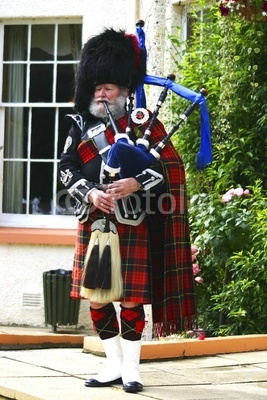
Can you honestly see somebody running through the Highlands dressed like this?
Monday, 22 July 2013
THE PRESBYTERIAN CONUNDRUM
In 1558, John Knox published in Geneva a book entitled, 'The First Blast of the Trumpet Against the Monstrous Regiment of Women.' This was a clear broadside against Mary Tudor, whom Protestants named 'Bloody Mary,' even though she killed less Protestants than her father or even John Calvin did! Rather unfortunately, Knox did not differentiate between Catholic women and Protestant women. Instead he railed against any kind of female ruler, quoting the Bible at length to prove his point that men should not be ruled by a woman. As events turned out he would have been better saying nothing at all.
Mary Tudor died prematurely and was succeeded by her half-sister, Elizabeth. When their brother, Edward VI had been on the throne, Knox had been a leading light in the Church of England, helping to direct it on a Reformed path. Any chance that he might do the same under Elizabeth was blown out of the water by his ill-conceived book. Elizabeth, like her father, was a firm believer in the divine right of monarchs and no jumped-up ex-priest was going to change her mind!
Elizabeth was in rather a precarious position. The Pope had condemned her as a bastard and not entitled to the throne of England. He had made it clear that Catholics in England were not obliged to obey her and would not be condemned for getting rid of her. This had the effect of making English Catholics automatically untrustworthy and potentially traitorous. Unfortunately, Knox's book was equally a threat to Elizabeth and Presbyterians were viewed with just as much suspicion as Catholics.
This distrust of Presbyterians continued into the Stuart dynasty. There was an attempt to bring the Scottish Church to heel and to bring the churches of both countries under the Episcopalian mantle of the Church of England. Of course, the Presbyterians resisted this. Many were sent out of the way to the 17th Century equivalent of Botany Bay: Ulster.
These Presbyterians fared no better in Ulster, having no rights in law unless they submitted to the authority of the Anglican Church of Ireland. And then came 1690. The Catholic James II raised an army in Ireland to win back his throne from William of Orange. When he attacked Ulster every man was needed and the Scottish Presbyterians were there to stand against him and defeat him.
Of course, when the emergency was over, these Presbyterians were no longer needed and went back to their old position of being persecuted. Many of them fled to America to escape this persecution, their descendants living in America to this day.
They were needed again in the 19th Century when Irish Nationalism gradually became predominantly Catholic. By the end of the century they were being courted by the likes of Joseph Chamberlain, who saw Gladstone's proposed Home Rule Bill as threatening his dreams of empire.
The Presbyterians were needed yet again when Home Rule was once more on the agenda under Asquith's pre-First World War government. This time they were needed to fight again and arms were smuggled to them from Germany of all places!
After the war, when Irish independence came into being, the Presbyterians were relied upon to provide a majority when Ulster was gerrymandered into six counties to ensure Protestant rule. Since then they were encouraged to see themselves as 'the masters' in the province, while their cousins in Scotland were encouraged to support them with their drums, flutes and sashes and by voting for the Conservative and Unionist Party.
In modern times things have changed a bit. The Establishment became embarrassed by the rampant bigotry shown by Ulster Presbyterians and there has been a lot of work to achieve some kind of equality and power sharing. Also, voting in Scotland tended to be along class lines, rather than religious; a fact acknowledged when the 'Unionist' element was dropped from the Conservative Party's name.
There remains, however, a hard core of these Scottish Presbyterians, both in Scotland and Northern Ireland, who are opposed to any changes. The call to arms has gone out again. The old name has been dusted off and David Cameron was to be seen recently beside a background poster that read, 'Conservative and Unionist Party.' Of course, as they have always done, the hard core of these Presbyterians have heeded the call.
Why are they needed this time? The threat comes from next year's vote on Scottish independence. And if you don't believe me abut how these people are being used then take a look at some blogs ostensibly devoted to Rangers. Day in, day out, there are folk on these blogs claiming that the call for Scottish independence is a Catholic conspiracy. Just as on every occasion in history, those in charge know exactly which buttons to press to manipulate these people.
So a call to the Presbyterians of this country. Are you going to think for yourselves or are you going to let yourselves be used as you have always done? Look back and see what rewards you received for your compliance in the past: none! Let's forget any supposed religious aspects to this vote and decide purely on practical and pragmatic grounds.
Vote YES.
Sunday, 21 July 2013
THE MYTH OF NORTH BRITAIN
At the end of the 18th and into the start of the 19th Century Scotland was a hotbed of intellectual activity. The Scottish Enlightenment was in full swing and Scottish thinkers were internationally renowned. People like David Hume and Samuel Johnson led the way in the fields of philosophy and even lexicography. Yes, Scotland was at the forefront of European intellectualism, but, strangely, the people that were driving this great movement did not see it this way.
All the leading lights of the Scottish Enlightenment never mentioned the name of Scotland in their conversations and writings. They spoke instead of 'North Britain.' Scotland was an anachronism and its future lay in being part of a united Britain; hence their new name for their country.
Just like they were all taken-in by the Ossian fraud, however, these intellectual giants were also deluded in seeing 'North Britain' as being an equal partner in the Union. There were plenty of geniuses in England too at this time but not one of them ever spoke of 'South Britain.' In fact, nobody in 'South Britain' ever used this expression. It was England, pure and simple. Indeed, many in England never even used the term 'Britain.' If you look back at speeches or newspaper articles of the period you will find that England was at war with Napoleon, not Britain. Equally they spoke of the 'English' Empire, the 'English' monarch, the 'English' Government etc etc. Looking back now it seems that David Hume and his contemporaries were living in a wee fantasy world of their own making.
And this sort of thing is still going on. We all get told how those in favour of Scottish independence are 'racist' and blame the English for everything. What we are not told, however, is how racist many English people are towards the Scottish.
At the last election many English newspapers used disgusting, racist language to describe Gordon Brown. 'A one-eyed Scotch git' was one epithet. Why should the English be governed by a Scotsman?' was the cry.
Equally there was condemnation of the way that Labour relied on Scottish MPs to push through laws that affected the whole of the UK. There were many comments about how England was having laws imposed on it by 'Scotch' MPs. Of course, no mention was made of how Scotland had been used as a testing-ground by the predominantly English Thatcher government! It seems that scenario is totally different.
So, essentially, what these newspapers and commentators were saying was that it was okay for Scotland, as part of the UK, to have laws imposed by English MPs, but it was totally unacceptable if it happened the other way round! Of course, none of this was published in the Scottish editions of these newspapers!
So what we have is a Union that is not really a union at all. England is to dictate what goes on in Scotland and, indeed, Wales and heaven forfend that the 'Celtic Fringe' should act as equal partners by having MPs that dare to vote in legislation that might affect England as part of the UK!
This is just one of the reasons I'll be voting YES to independence next year. North Britain and South Britain never existed; all that matters to England is England and it is about time we felt the same about our country!
Subscribe to:
Posts (Atom)